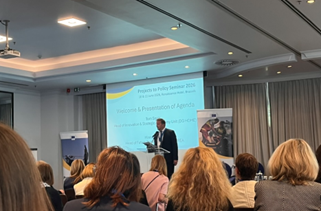
Research only delivers its full value when it reaches the people who shape policy. On 10–11 June 2026, at the Renaissance Hotel in Brussels, ARTEMis put that principle into practice at the Projects to Policy Seminar 2026, bringing its mission for EU disaster resilience directly to European policymakers and EU agencies.
The Projects to Policy Seminar (PPS) is an annual event co-organised by the European Commission’s Directorate-General for Migration and Home Affairs (DG HOME) and the European Research Executive Agency (REA), held within the framework of the Community for European Research and Innovation for Security (CERIS). Opened this year by Tom Snels (DG HOME) and Minna Wilkki (REA), it pursues a twofold purpose: to keep newly launched Horizon Europe Cluster 3 “Civil Security for Society” projects informed of the latest EU policy developments, and to make Commission policy officers aware of emerging research results and innovative solutions. In short, it is where European security research and European policy meet.
For the ARTEMis project launched in October 2025, the 2026 edition arrived at an ideal moment, offering an early opportunity to position the project within the wider European disaster resilience agenda.
A programme built around impact and uptake
The seminar opened with a policy roundtable bringing together four Commission departments, DG HOME, DG ECHO, DG TAXUD and DG MARE, setting the strategic context for the two days that followed. Dedicated plenary sessions then addressed the themes most closely tied to real-world impact: dissemination and exploitation in security research, lessons learnt in communication, and feedback to policy. For a project whose dissemination, communication and exploitation work is central to its mission, these were discussions of direct and immediate relevance.
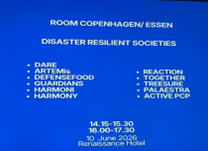
A place in the Disaster Resilient Societies conversation
ARTEMis contributed to the seminar’s Disaster Resilient Societies (DRS) breakout sessions, taking part as one of eleven DRS projects, alongside its sister project and a strong cohort of resilience-focused initiatives. Together, these projects shared a common ambition: to move Europe’s emergency alert and crisis response systems away from fragmentation and toward genuine interoperability across borders.
On the second day, the breakout groups were deliberately reshuffled across thematic areas, placing disaster-resilience projects alongside teams working on border management, resilient infrastructure, and the fight against crime and terrorism — encouraging cross-domain exchange on the premise that resilience solutions often emerge from outside a single field.
Throughout the discussions, ARTEMis framed its work in operational rather than purely technical terms. Instead of focusing on underlying algorithms and data pipelines, the project emphasised the capability it is building — a harmonised approach to impact-based forecasting and emergency alert harmonisation, powered by Artificial Intelligence and Earth Observation, that enables responders in any member state to act on consistent, actionable information. This focus speaks directly to EU frameworks such as DG ECHO’s Preparedness Union Strategy and the Union Civil Protection Knowledge Network, which encourage exactly this kind of cross-border, evidence-based resilience.
From the policy table to the pilots
The Projects to Policy Seminar 2026 reaffirmed a conviction at the centre of ARTEMis’s dissemination strategy: the distance between a strong research result and real policy uptake is closed by clear communication, attentive listening to institutional needs, and deliberate alignment with strategies already in motion at EU level a message reinforced by the seminar’s own closing sessions on exploitation and innovation uptake.
ARTEMis left Brussels with refined messaging, valuable new contacts across the Commission and EU agencies, and a clearer understanding of its place within the EU disaster resilience landscape. The project’s pilot lines will begin generating real-world data from late 2026. That evidence will form the basis of ARTEMis’s contribution to future editions of this research-to-policy dialogue.
ARTEMis is a Horizon Europe Innovation Action (GAP-101225852) harmonising emergency alert systems and AI/Earth Observation-driven impact forecasting across EU member states. The project runs from October 2025 to September 2028 and brings together 16 partners across Europe.
Funded by the European Union. Views and opinions expressed are however those of the author(s) only and do not necessarily reflect those of the European Union or the European Commission. Neither the European Union nor the granting authority can be held responsible for them.