Disaster resilience research keeps producing breakthroughs — in hazard monitoring, in forecasting, in hydrology. The harder problem, and the one that matters most in practice, is turning that research into tools that governments and emergency responders can actually pick up and use. That challenge sits at the heart of ARTEMis, and it’s also exactly what came up on the international stage this summer at the AI for Good Global Summit in Geneva.
A field-wide conversation
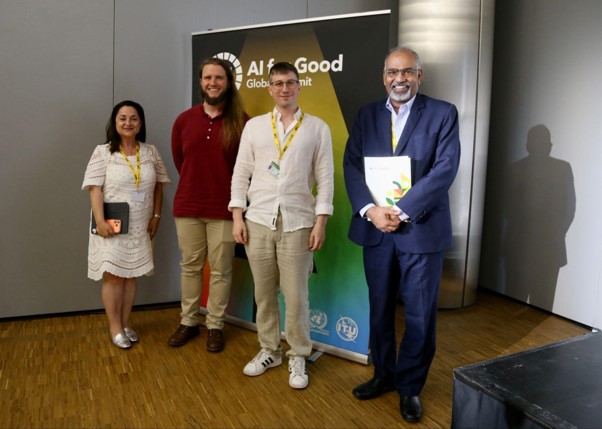
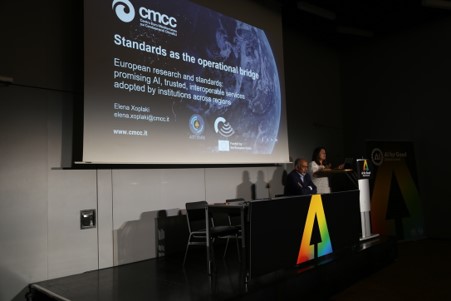
On 7 July 2026, the summit’s Day Zero programme at Palexpo hosted a panel titled “AI in disaster resilience: Bridging science, standards and innovation,” convened under the Global Initiative on Resilience to Natural Hazards through AI Solutions — the ITU-hosted platform connecting researchers, standards bodies, and technology developers working on natural hazard management. The panel brought together senior figures from the World Meteorological Organization, the European Centre for Medium-Range Weather Forecasting, UN-Habitat, and the European Space Agency, alongside Elena Xoplaki representing MedEWSa, a Horizon Europe project that has spent three years building a Decision Support and Dissemination System tested across eight pilot sites in Europe, the Mediterranean, and Africa. The themes raised in that room, closing the gap between research and operational deployment, and building shared standards for AI-enabled early warning, are the same ones ARTEMis is built around.
MedEWSa’s work is wrapping up: ARTEMis picks up where it leaves off
MedEWSa runs through October 2026, and as the project reaches its conclusion, it leaves behind a substantial body of tested, real-world evidence: a working platform that links forecast production, impact assessment, and warning dissemination, proven across a diverse set of pilot sites. That’s not a small thing to hand off. It’s a foundation.
ARTEMis is the next step. Where MedEWSa focused on building and testing a forecast-to-warning system across the Mediterranean and Europe, ARTEMis is scaling the ambition further, pan-European in reach, deeper in stakeholder engagement, and structured around ecosystem-building as a core task from day one. The questions MedEWSa’s team brought to Geneva, how do we get AI-driven forecasting tools past the research stage and into the hands of the people who respond to emergencies, and how do shared standards make that possible across borders and organisations, are questions ARTEMis is now carrying forward.
Why this continuity matters
Early warning systems only work if they’re built cumulatively. No single project closes the gap between science and operations on its own; the field advances when one project’s tested infrastructure, lessons, and stakeholder relationships feed into the next. As MedEWSa closes out its three-year mandate, ARTEMis is positioned to build directly on that groundwork, engaging with the same community of research partners, standards bodies, and responder networks that gathered in Geneva, and pushing further toward operational, cross-border early warning tools.
This is also why ARTEMis places such weight on ecosystem building: cohesion across EU systems, active collaboration with research and innovation networks and public-private partnerships, and direct engagement with first and second responders internationally. The AI for Good Summit was a reminder that this isn’t work ARTEMis does in isolation: it’s a continuation of a mission the wider field has been building toward, and one ARTEMis is now well placed to carry into its next phase.